New Orleans Mississippi River Student Attack
Secret InvasionThe New Orleans Mississippi River Student Attack is a nighttime waterfront assault in which a submerged creature takes Daniel from a group of friends and later pulls Steve underwater, where he drowns. Its defining terror is the gap between what the witnesses can see and what the river conceals: a camera flash briefly catches a dark-green shape, but the attack itself unfolds in splashes, disappearance, and desperate cries from the water. The incident brings the wider Sligger threat into the heart of New Orleans, where the river’s ordinary scale and public setting offer no protection.
Setting and Wider Emergency
The attack occurs against a growing public awareness of dangerous sea creatures along the East Coast. National news broadcasts warn people to stay indoors at night and avoid the water until authorities declare areas safe; social media spreads the warnings alongside jokes and movie-inspired memes. Fear and humor coexist, but neither makes the danger remote. In Sweetboro, where residents still remember the previous year’s attack, some families leave the coast for inland homes, while others board up windows, reinforce doors, and clean and stock ammunition for their guns. The town’s response shows how the threat has turned ordinary domestic routines into preparation for a possible siege.
Other communities organize differently. Savannah concentrates police along the Savannah River after the massacre at the Jekyll Island campground, even as River Street remains busy with diners, pub patrons, gallery visitors, and people watching ships and riding historic riverboats. Civilian hunters, meanwhile, seek places beyond populated areas where they can search without police interference. The attack in New Orleans belongs to this broader crisis of exposed waterways and improvised responses, although the evidence does not establish that it directly prompted the actions taken in Sweetboro or Savannah.
The Friends at the Waterfront
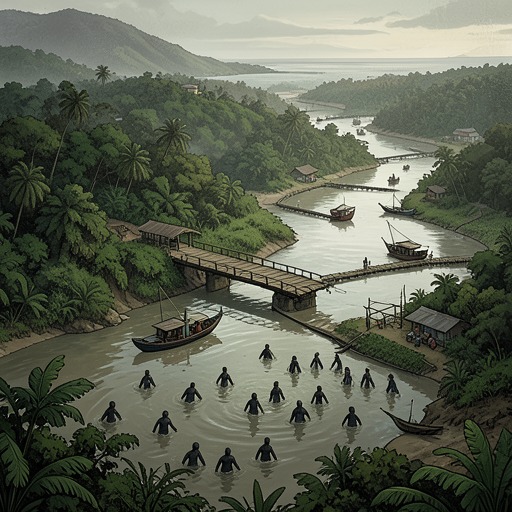
Before the attack, the young people cross the street and climb to the cannon monument at Washington Artillery Park to look out over the Mississippi River. Kimmy wants a closer view, so she leads the group across three train tracks and up another set of stairs to the waterfront sidewalk. The river’s breadth becomes part of the scene: Kimmy estimates it at half a mile across, using the lights of freighters moving upriver to gauge the distance. The vast waterway is at once a spectacle and a familiar public place, approached by friends out together rather than by people expecting to face danger.
The mood changes when the group notices a bad smell. Kimmy raises her phone to photograph the young men, and the flash illuminates them. In that brief burst of light, she thinks she sees something dark green behind them, shaped like a large, wet snake. A heavy splash follows. The flash provides only a fragmentary glimpse, not a warning the group can act on; when Steve turns toward the spot, Daniel is no longer standing there. The scene makes visibility itself unreliable: the most revealing image lasts only an instant, while the river quickly hides what has happened.
The Attack and Its Fatal Turn
Steve backs away from the water and says that something seems to have snatched Daniel. The friends scan the river, then see a hand break the surface. Daniel’s head emerges, and he calls for help in a voice his friends have never heard from him before. He appears to move upriver against his will, as if something is pulling him. Steve leads the others along the waterfront sidewalk, and they run beside the river to keep pace with him.
Daniel calls out again, but his words become labored, as though something is squeezing the air from him. His head then disappears beneath the surface. Kimmy cries his name; the group slows and stops. The account does not confirm Daniel’s ultimate fate after this disappearance, but it shows the sudden helplessness of the witnesses: they can follow the waterline, call to him, and watch, yet they cannot reach the force dragging him below.
Steve later resurfaces for air and feels something wrap around his thigh. The grip tightens with immense strength and pain, and he is pulled underwater. He kicks and struggles toward the surface, but cannot break free from whatever is anchoring him. As water enters his airway, he loses consciousness and drowns. Passersby gather around the women screaming on shore, but the river has gone quiet. Steve’s death makes the attack’s danger unmistakable; the creature is not merely glimpsed near the waterfront but can seize a person and overpower him beneath the surface.
Public Response and Significance
The wider response to the Sligger crisis includes both official warnings and civilian action. In Savannah, Molly Foster assembles friends willing to hunt for nests; raised in a military family, comfortable with guns, and taught to hunt by her father, she takes her best shotgun on the group’s nighttime search. Later, after the president declares a National State of Emergency in response to a second wave of migration and announces Army Reserve support for the National Guard, Molly calls Deputy Norman Linneman for more information. She knows him from three occasions when he responded to clean up after her group destroyed nests along the Savannah River. These efforts belong to the wider campaign against the creatures, not to a response shown as caused by the New Orleans attack.
The waterfront scene gives that emergency a sharply local form. Earlier, the river’s width, freighters, stairs, and train tracks invite Kimmy and her friends to look more closely; then the same open water becomes a hiding place from which people are taken. The attack’s decisive shift is from casual observation to desperate pursuit, and from pursuit to helpless witnessing. In a crisis that encourages people to avoid the water, the river is not simply a boundary or a view: it is an active danger whose surface gives the people on shore only partial evidence of what is happening below.